
July 16, 2026
Your AI Readiness Gap Isn't a Data Problem. It's a Perception Gap.
If your plant has historians running, systems collecting, and dashboards reporting, why isn't it ready for AI? The answer isn't more sensors. It's context.
Leadership sees the dashboards and years of collected readings and assumes the plant has what it needs to move on AI. The people on the plant floor know otherwise. That data was built to run one machine or feed one screen. Outside the system that generated it, it loses its meaning.
That gap between what leadership envisions and what the plant floor experiences is where AI readiness conversations stall. Leadership envisions the data is there. The floor experiences something different. Leadership assumes the data is there. The floor responds, "Yes, but." And the instinct on both sides is the same: if the success of an AI integration project relies on data, we just need to collect more by adding more sensors.
But most plants already collect more data than they can use. Meaning the AI readiness gap isn't data volume. It's context.
The Volume Myth
Most plants assume the path to AI is collecting more data. Add sensors. Add readings. Add dashboards.
That instinct solves the wrong problem.
Boston Consulting Group’s 10–20–70 framework makes the imbalance clear.
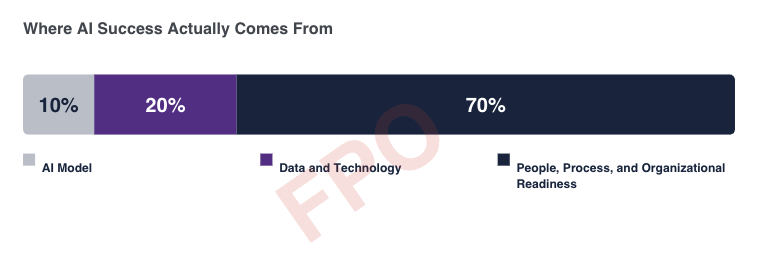
The Volume Myth lives in that 20%.
To accelerate AI projects, plants invest in collecting more data, believing scarcity is the issue. As a result, operations can end up actually having more data than they can use.
This is where the perspective gap between leadership and the floor becomes visible. Leadership sees a broad picture of the operation. The floor sees the details inside the systems that keep the plant running. They are looking at the same environment from different perspectives.
The shortage isn’t volume.
The data isn’t the problem.
The context is. It’s inconsistent tags, siloed systems, and meaning that doesn’t carry across systems.
Instrumented vs. Integrated
These terms are often used interchangeably, though they shouldn’t be. There are actually several key distinctions that can be surprisingly easy to miss.
Instrumented systems reliably capture what happens on the floor. Each system contains accurate data within its own boundaries. Getting one trustworthy answer out of several instrumented systems still requires manual pulls, spreadsheets, and cross-checks.
A plant becomes integrated when data can move between systems without losing meaning. Tags mean the same thing in engineering, operations, and the front office. Information can be accessed without manual reconciliation, and its accuracy is maintained over time by an assigned owner.
Chase Davis, Controls/Automation Engineer at EOSYS, has seen this play out on the floor.
"If they have multiple machines that are supposed to be the same, but they're structured very differently from each other, that needs to be resolved. If these machines are the same, the data at least needs to be structured the same, so AI knows that these two machines are exactly the same,"
Most plants are actually closer to instrumented than integrated. Their systems work. The signal exists. It just can't travel where it's needed. That's the context challenge, and it's what limits AI readiness regardless of how much data a plant collects.
Plant-ready AI depends on data that carries its meaning from one system to the next. When it doesn’t, the operation isn’t ready for AI, no matter how much data it collects.
Why Context is the Harder Challenge
Collecting more data sounds like progress, but it is rarely a step that moves a plant closer to being ready for AI when conducted on its own. Adding sensors or new data streams still requires hardware, software, labor, and funding, and it often creates more information without improving how that information can be used.
Fixing context is harder because it requires ongoing work. Naming conventions, tagging standards, governance, and ownership ((link to governance)) all have to be defined and maintained. This work does not show up on an equipment list, and it cannot be solved with a single purchase. It is part of the operational discipline that makes data reliable over time.
The context challenge does not go away once systems are integrated. Without ownership, data quality slowly drifts. Systems continue talking to each other, but confidence in the numbers erodes. That erosion directly affects AI readiness. AI depends on data that stays consistent, trusted, and meaningful across every system that touches it.
Most of what determines AI success is not technical. It is organizational. To be ready for AI, plants need clear data ownership and accountability. Someone has to be responsible for keeping data meaningful, and someone has to ensure it stays that way. Many manufacturers rely on integration partners grounded in real plant operations. Companies like EOSYS help maintain the standards and ownership that keep data consistent across systems.
Where the Context Challenge Shows Up
A quality flag fires on the line, but never reaches the operator who could act on it because the alert lives in a different system. Leadership sees a report that shows the flag was captured. The floor sees that nothing reached the person who needed to respond.
An AI model produces a result that looks promising in a dashboard, but the floor does not trust it because the underlying data was never aligned across systems. Leadership sees a model output. The floor sees inputs that were inconsistent from the start.
In both cases, the data existed. The context did not. This is the context challenge that defines AI readiness. Leadership sees the operation from a higher level. The floor sees how the systems behave in real time. AI only works when those two views match.
What Has to Work Before AI Can Succeed
Getting ready for AI does not start with buying more hardware or adding more sensors. It starts with a clear look at the data, systems, and practices a plant already has, and whether they can support AI in a consistent and trusted way.
To move toward AI readiness, plants need to understand how their current data behaves and where meaning may be lost.
Foundational Work
|
A plant that does this work is preparing its systems to support AI. It is making sure its data stays consistent, trusted, and meaningful across every system that touches it.
The question is not whether a plant has enough data for AI. Most do.
The question is whether that data stays aligned, trusted, and understood everywhere it needs to be. That's the context challenge, and closing it is where AI readiness actually begins.
Questions Worth Asking About AI Readiness and Data
The most reliable signal isn't volume. It's whether a number means the same thing in every system that touches it. If your team still reconciles data manually before trusting a report, or if a tag means one thing to the engineer who set it and something different to the analyst three systems away, the data isn't ready. The gap isn't what you're collecting. It's what that data can do once it leaves the system that made it.
Instrumented means your systems are reliably capturing what happens on the floor. Each system holds accurate data within its own boundaries. Integrated means that data can move between systems without losing its meaning. Tags are consistent across engineering, operations, and the front office. Anyone can pull a number without a manual reconciliation step.
Because the data was built for operations, not for AI. The systems capture what keeps the plant running, but that data was never built to carry its meaning from one system to the next. When an AI initiative tries to use it, the tags are inconsistent, context doesn't travel, and the outputs the model produces are ones the floor doesn't trust enough to act on. The data existed. The context didn't.
More than most plants budget for. Naming conventions and tagging standards have to be defined, maintained, and kept consistent as systems change. That work doesn't show up on an equipment list and can't be solved with a single purchase. Without an assigned owner, data quality drifts quietly until an AI initiative depends on accuracy that is no longer there. Most of what determines AI success is organizational, not technical. Data ownership is exactly where that work lives.
Having those systems running means the plant is instrumented. That's necessary, but it isn't sufficient. The question is whether the data those systems generate can move, carry its meaning, and be trusted by someone outside the system that produced it. Leadership often sees active systems as confirmation of readiness. The floor knows the data still requires manual pulls and cross-checks before it can be used for anything beyond its home system. That perspective gap is where most AI readiness conversations stall.
Start with an inventory, not a purchase order. Map where data already lives before adding new collection points. Standardize tagging across systems so a number means the same thing in engineering and in the front office. Assign data ownership as a named responsibility, not a side task. Then build the connective layer between historian, MES, and ERP before scoping any AI use case against it. A plant that does this work isn't chasing more data. It's making the data it already has ready for AI to use.